
Choosing the right acoustic panel is not simply a matter of selecting the highest Noise Reduction Coefficient (NRC) available. The best acoustic panel thickness and NRC depend on the space, the type of sound being controlled, the installation method, and the performance required from the finished application.
For architects, acoustic product fabricators, manufacturers, and commercial buyers, understanding these specifications can make it easier to compare materials and choose an acoustic panel that fits the project.
What Is NRC for Acoustic Panels?
NRC, or Noise Reduction Coefficient, is a single-number rating used to describe how much sound a material absorbs across a defined range of frequencies. In general, a higher NRC indicates greater average sound absorption under the conditions in which the material was tested.
However, NRC should not be the only specification considered. NRC represents an average, which means it does not show exactly how a material performs at every frequency. If a project needs to address a particular sound profile or frequency range, reviewing the full sound absorption data can provide more useful information than comparing NRC alone.
How Does Acoustic Panel Thickness Affect Sound Absorption?
Panel thickness is one of the major variables that influences acoustic absorption. In general, thicker porous acoustic materials can absorb more sound energy and provide stronger acoustic performance than thinner versions of similar materials.
That does not mean every project requires the thickest available acoustic panel.
A thinner panel may make sense for decorative wall systems, desk screens, ceiling treatments, acoustic art, or fabricated products where space, weight, appearance, and acoustic performance all need to be balanced.
A thicker panel may be a better fit when greater sound absorption is a priority, especially in larger or more reverberant environments.
The goal is to choose an acoustic panel thickness that delivers the required performance while still fitting the physical, fabrication, and design requirements of the application.
What Is a Good NRC Rating for an Acoustic Panel?
There is no single NRC rating that is best for every project. A good NRC rating is one that matches the acoustic goals of the intended application.
Bouckaert Industrial Textiles currently offers standard Poly-Sonic polyester acoustic panels ranging from approximately 0.354 inches to 2 inches thick, with published A-mount NRC ratings ranging from 0.30 to 1.01.
Standard Poly-Sonic options include:
- Poly-Sonic 56354: 0.354-inch thickness, NRC 0.30
- Poly-Sonic 56500: 0.5-inch thickness, NRC 0.50
- Poly-Sonic 70500: 0.5-inch thickness, NRC 0.50
- Poly-Sonic 721000: 1-inch thickness, NRC 0.75
- Poly-Sonic 1101000: 1-inch thickness, NRC 0.81
- Poly-Sonic 1442000: 2-inch thickness, NRC 1.01
This range gives buyers multiple combinations of thickness, density, and acoustic performance to consider rather than requiring every application to use the same panel specification.
Why Does the NRC Test Method Matter?
When comparing acoustic panels, buyers should make sure NRC values were generated under comparable test conditions.
ASTM C423 is a standard test method for measuring sound absorption in a reverberation room, while ASTM E795 addresses mounting test specimens during sound absorption testing.
Mounting conditions matter because they can influence measured acoustic performance. For example, BITFelt notes that a panel tested directly against a hard surface using an A-mount configuration can produce a different NRC than a panel tested in a suspended configuration with space behind the material.
For that reason, buyers should avoid comparing NRC numbers without also looking at how the materials were tested.
Poly-Sonic’s standard product specifications identify the published NRC values as A-mount ratings, and Bouckaert Industrial Textiles provides technical documentation for acoustic and flammability testing.
Should You Choose a 0.5-Inch, 1-Inch, or 2-Inch Acoustic Panel?
A 0.5-inch acoustic panel can be a good choice when a lower-profile material is needed while still adding sound absorption. It may fit applications where available depth, fabrication requirements, or visual design limit panel thickness.
A 1-inch acoustic panel offers increased absorption performance. Poly-Sonic’s standard 1-inch products carry published NRC ratings of 0.75 and 0.81, providing options for projects where stronger acoustic performance is required without moving to a 2-inch profile.
A 2-inch acoustic panel can be considered when maximizing sound absorption is a higher priority. Poly-Sonic’s standard 2-inch panel carries a published A-mount NRC rating of 1.01.
Thickness alone should not determine the final selection. Density, mounting configuration, target frequencies, panel placement, treated surface area, and fabrication requirements can all influence which specification makes sense.
When Does a Custom Acoustic Panel Specification Make Sense?
Some projects require a different combination of thickness, density, dimensions, color, stiffness, or acoustic performance than a standard panel provides.
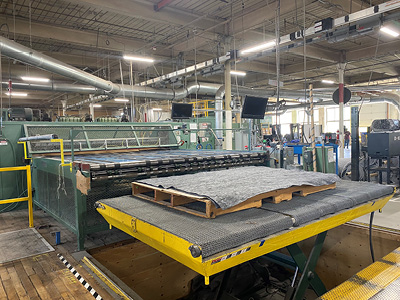
Bouckaert Industrial Textiles can customize Poly-Sonic based on weight, thickness, sheet size, density, and color. Poly-Sonic is also available as finished boards or rolled goods for companies with their own heat-setting or molding capabilities. The material is manufactured in the United States from 100% polyester, with at least 60% recycled content.
Custom manufacturing can be particularly useful when an acoustic product fabricator or designer needs the substrate to fit an existing product design rather than building that design around a fixed stock panel.
Choosing the Right Poly-Sonic Acoustic Panel
The right acoustic panel specification starts with the application. Determine the level of sound absorption required, identify important frequency ranges, understand how the material will be mounted, and establish practical requirements for thickness, density, dimensions, color, and fabrication.
From there, NRC becomes a useful comparison tool rather than the entire decision.
With standard Poly-Sonic options ranging from thin, lower-profile panels to 2-inch products with higher published sound absorption, Bouckaert Industrial Textiles can support a variety of architectural, commercial, and fabricated acoustic applications. If a standard specification does not fit the project, Poly-Sonic can also be customized around specific performance and manufacturing requirements.